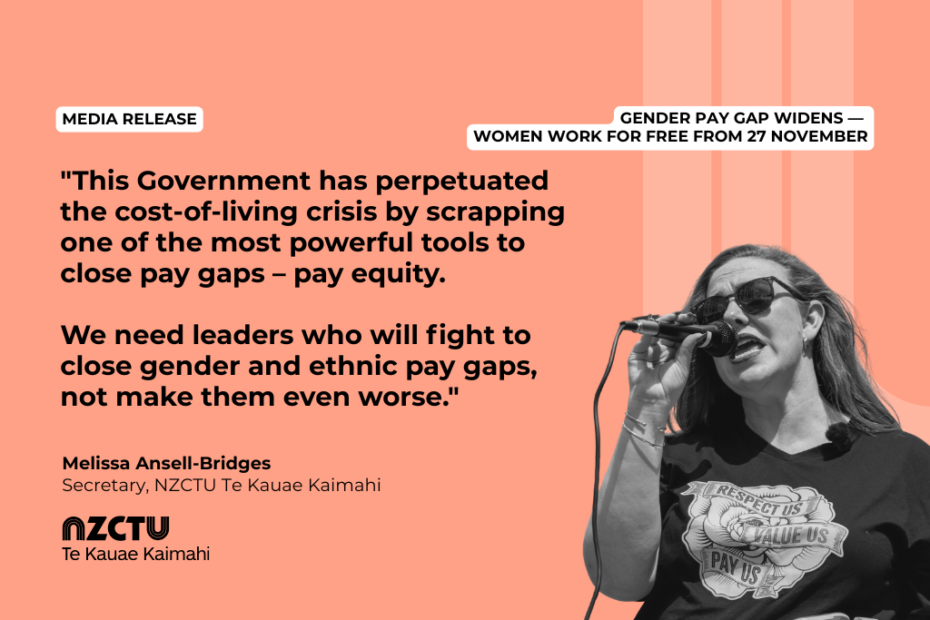
Today, the New Zealand Council of Trade Unions Te Kauae Kaimahi released the 2026 Work for Free Calendar which shows the scale of systemic pay inequality facing women across Aotearoa and the devastating impact of the Government’s gutting of pay equity.
“Data released today by Stats NZ shows that the pay gap between men and women has gotten larger over the past year,” says Melissa Ansell-Bridges, Secretary of the NZCTU Te Kauae Kaimahi. Using the mean measure, the gender pay gap was 9.6% in the June 2026 quarter, up from 8.7% last year. This means that women effectively start working for free compared to men from 27 November.
When women of different ethnicities are compared to Pākehā men, the difference is even starker. Pacific women are the first to start working for free on 1 October. Māori women start working for free from 20 October and Asian women start working for free on 21 October. Pākehā women follow on 20 November.
“This Government has perpetuated the cost-of-living crisis by scrapping one of the most powerful tools to close pay gaps – pay equity,” says Ansell-Bridges. “We need leaders who will fight to close gender and ethnic pay gaps, not make them even worse.”
“Women working for free, for months, in critical jobs in health, community care, and education is a shameful stain on our proud gender equality record,” says Dame Judy McGregor, spokesperson for the Pay Equity Coalition Aotearoa. “It comes on top of the cruel, secretive and deliberate axing of pay equity and a crippling cost of living crisis which hits women and families hardest. Women can use their vote on 7 November by choosing parties that will restore pay equity as an immediate priority”.
Teresa Tepania-Ashton, CEO of YWCA Tāmaki Makaurau, says that “The Work for Free Calendar is a stark reminder that women are still not being equally valued for the work they do. For Māori and Pacific women, that inequity begins even earlier – and that should concern all of us”.
“Pay inequity has a real and lasting impact on women, their whānau and communities,” adds Tepania-Ashton. “Closing the gender pay gap requires deliberate action to remove the structural barriers that continue to hold women back.”
“Women deserve better,” adds Ansell-Bridges. “They deserve political leaders that take action to close pay gaps and ensure that everyone is paid 100 percent of what they’re worth.
“The National-led Government has done the opposite. By destroying the pay equity system, the Luxon government has made it much harder for women and marginalised workers to ensure they are paid what is fair and what they are owed.”
2026 work for free dates:
Compared to Pākehā men, on average the following groups start to work for free from:
- Pacific women: 1 October
- Pacific men: 18 October
- Māori women: 20 October
- Asian women: 21 October
- MELAA women: 2 November
- Māori men: 9 November
- Pākehā women: 20 November
Note:
These dates are based off the average (mean) wage gap. Women of different ethnicities are compared against Pākehā (European NZ) men, and Māori and Pacific men are compared against Pākehā men.
Stats NZ uses median figures to calculate the wage gap. The NZCTU prefers to use the average (mean) figures to calculate the wage gap, as this measure reflects the full diversity of women’s work. It captures the influence of low-paid and high-paid workers, with Pākehā men over-represented in higher-paying roles, and women from non-European ethnicities concentrated in lower-paying sectors and occupations. These figures have been released by NZCTU alongside Still Minding the Gap, PECA, and YWCA.