As the election approaches, working people want to know where parties stand on the issues that matter to them. The NZCTU Te Kauae Kaimahi reached out to parties across the political spectrum and asked them 13 questions that workers told us were their priority this election year:
- Will you support higher wages by restoring Fair Pay Agreements in the first 100 days?
- Will you support women’s equality by restoring the pay equity system to its 2020 settings in the first 100 days?
- Will you support Care and Support workers by delivering the pay equity settlements in the first 100 days?
- Will you protect safety on the job by repealing the Health and Safety at Work Amendment Act 2026 before it takes effect?
- Will you protect job security by abolishing 90-day trials?
- Will you protect workers by ending the mislabelling of employees as contractors?
- Will you protect workers’ rights by restoring the personal grievance system?
- Will you make it easier for workers to access unions by introducing automatic opt-out union membership?
- Will you protect workers’ holidays and sick leave by repealing the Employment Leave Act 2026 before it takes effect?
- Will you help address the cost of living by setting the minimum wage above inflation for the next 3 years?
- Will you commit to paying the living wage across all arms of government, including contractors?
- Will you support young families to thrive by extending the length and value of paid parental entitlements?
- Will you reduce migrant exploitation by ending employer bonding in our temporary work schemes?
National and ACT declined to answer questions on their industrial policy. The stances listed here instead reflect their public statements and legislative history. If any political parties feel that their policy has been incorrectly stated, we encourage them to reach out.
Fair Pay Agreements
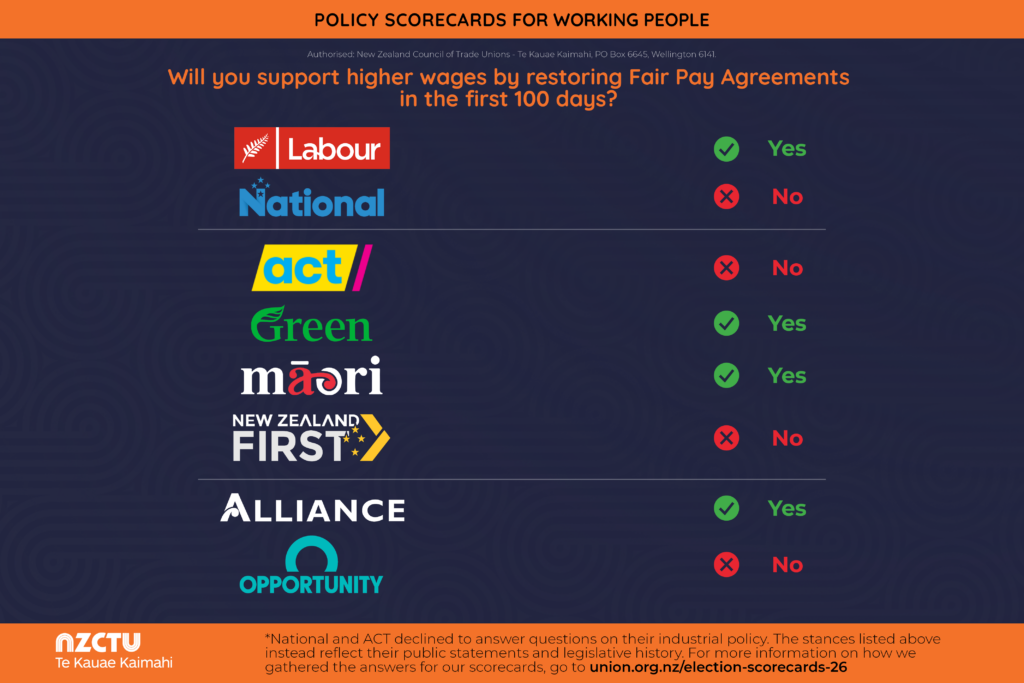
Why this matters: New Zealand’s lack of industry-wide bargaining has trapped too many working people in low-wage industries. Restoring Fair Pay Agreements will allow unions and employers to lift minimum pay and conditions across sectors that need it the most.
Sources for National and ACT‘s policy.
Contractors
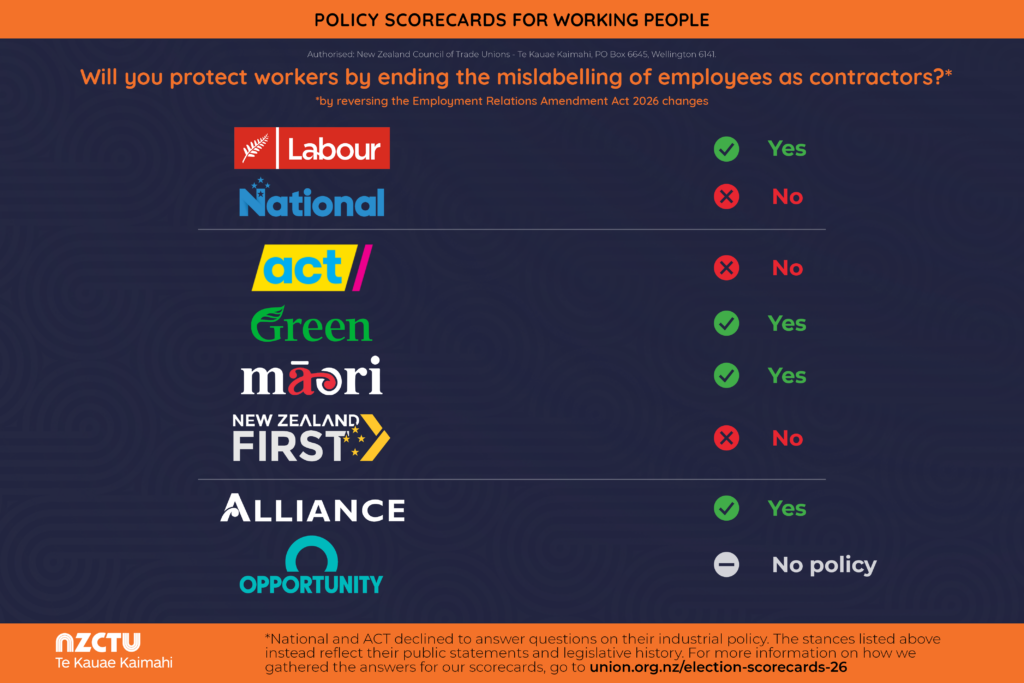
Why this matters: The “gateway test” introduced by the coalition Government has removed the ability of some workers to challenge their employment status in court, leaving them vulnerable to sham contracting arrangements.
Sources for National and ACT‘s policy.
Personal grievances
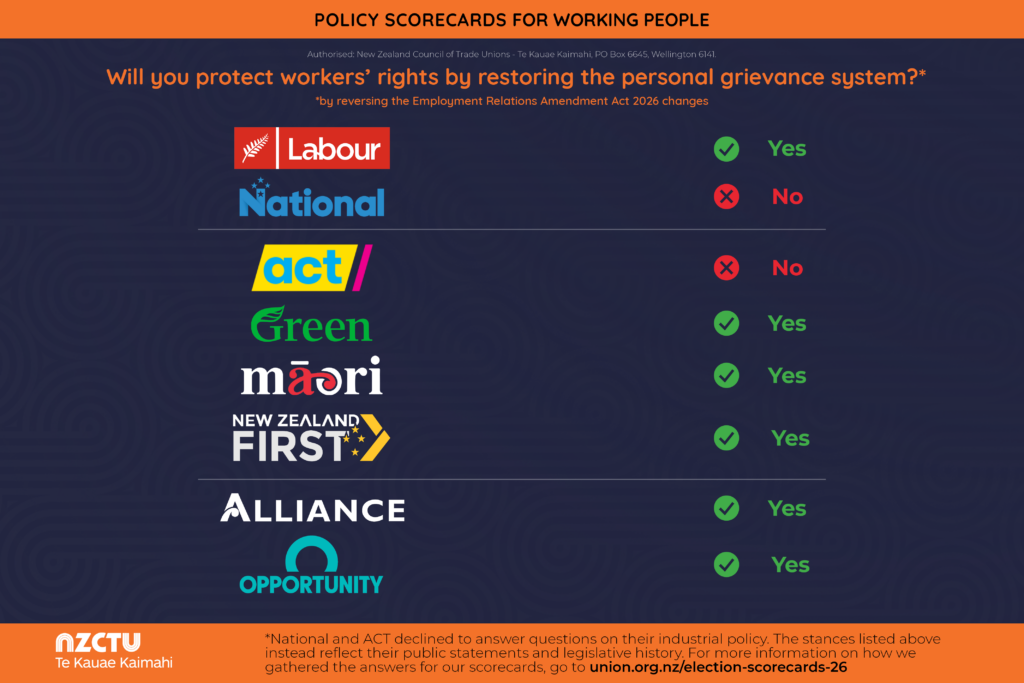
Why this matters: Personal grievance changes by this Government have weakened the system to favour employers, worsening the imbalance of power that exists in employment relationships.
Sources for National and ACT‘s policy.
Print out a scorecard
Want to talk to your friends, whānau, and coworkers about the issues that matter to you this election? Print out our scorecards below:
Note: All 13 scorecards will be available on 12 October
Sources for National and ACT policy
These answers have been filled on the party’s behalf as they did not respond to questions on their industrial policy. Answers are based on the party’s voting record over the last term of government, policy statements, and other public comments made by members of the party.
National
Fair Pay Agreements: The National Party campaigned heavily against FPAs while in opposition and made repeal of Fair Pay Agreements in government an election commitment. The National-led coalition government repealed the Fair Pay Agreements Act on 14 December 2023, as part of its first raft of legislative changes, with the repeal formally taking effect on 20 December 2023. All National Party MPs voted in support of the Fair Pay Agreements Repeal Act.
Contractors: The National-led Government introduced and supported the Employment Relations Amendment Act 2026, which introduced a test to prevent some workers from challenging their employment classification and opens the door to widespread misclassification. No information can be found indicating that National wants to reverse this policy.
Personal grievances: The National-led Government introduced and supported the Employment Relations Amendment Act 2026, which made significant changes to workers’ rights around personal grievances. All National MPs voted in favor of these changes. No information can be found that National would restore the personal grievance system to its pre-Amendment Act settings.
ACT
Fair Pay Agreements: The ACT Party strongly opposed Fair Pay Agreements while in opposition, stating that they would repeal them in Government. They did this through Minister Brooke van Velden’s Fair Pay Agreement Repeal Act pushed through the House under urgency with no consultation, with all Act MPs voting in favour of repeal.
Contractors: ACT led reforms regarding contractor status through the Employment Relations Amendment Act 2026 sponsored by Minister van Velden. The legislation introduced a statutory contractor ‘gateway test’ designed by Uber to limit workers from being able to challenge their contractor status. All ACT MPs voted in support of the law change.
Personal grievances: Changing personal grievance settings was a coalition agreement between ACT and National. In government, ACT sponsored and supported the Employment Relations Amendment Act 2026, which significantly restricted access to personal grievance remedies, weakened procedural requirements on employers in personal grievance processes, and introduced limits on unjustified dismissal claims for higher-income earners. All ACT MPs voted in favor of these law changes.