Any risk to health and safety identified must be dealt with.
Things used, and actions taken to address risks to health and safety are called control measures. Not all control measures provide equal protection to your health and safety.
The hierarchy of control measures
The process of managing risks and implementing control measures is required by law. Businesses must:
- First try to eliminate the risk, and if this is not reasonably practicable then;
- Minimise the risk much as possible (by reducing the likelihood it will occur, or how much harm it will cause) using the hierarchy of controls.
The hierarchy of controls is about ensuring that businesses look to implement the best, most effective control measures proportional to the risks arising from the work.
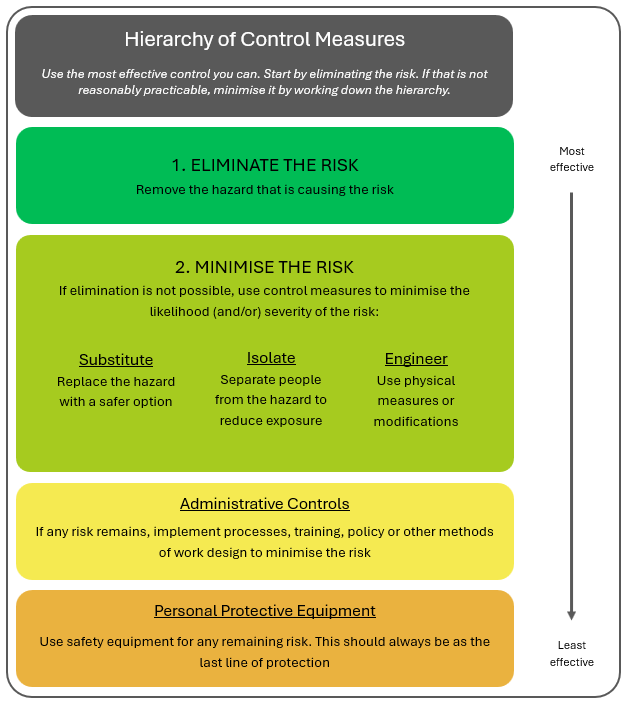
Control measures are more effective when:
- They protect everyone that could be exposed rather than individuals. For example, soundproofing noisy machinery rather than requiring hearing protection be worn; and
- When they don’t rely on human behaviour or intervention to be effective. These kinds of control measures can be undermined by accident, inadvertently, or even deliberately. This is why Peronsal Protective Equipment (PPE) and administrative controls sit at the bottom of the hierarchy.
Many risks will require multiple control measures to eliminate or reduce the risk to health and safety.
For workers
Have you been asked about managing risks in your workplace?
You and your union must be engaged when your workplace is deciding on what control measures are going to be implemented to manage risks to your health and safety.
You are the expert. As the person doing the work you are uniquely placed to explain what control measures will be the most effective, and what the implications of control measures would be.
Always seek to have risks eliminated in the first instance
Always seek the implementation of the strongest control measures. The hierarchy of controls is based on the effectiveness of the measures.
Remember that most risks will require a combination of control measures.
PPE should only be used where other control measures cannot mitigate the risk. It should never be the first consideration or only control measure.
Workplace health and safety should never come at a cost to you
You should never have to pay for any measures taken for health and safety. It is against the law to have workers pay for anything done or provided for health and safety at work.
If your work requires PPE, this must be provided by your employer. Putting on and taking off safety equipment (known as donning and doffing) is work-related and must be on paid time.
Managing risks is about continuous improvement
Control measures need to be monitored, reviewed, and updated. And you and your union must be involved.
Are control measures still effective, has work changed since those measures were introduced, have new risks arisen?
Also consider whether the introduction of any control measures is introducing new risks. For instance hearing protection may inhibit workers from hearing warnings or other risks.
Useful links
- WorkSafe General Risk and Workplace Management
- NZ Insititute of Safety Management HSR guide
- Hierarchy of prevention and control measures (Note any health and safety laws this resource might refer to may differ from New Zealand’s)