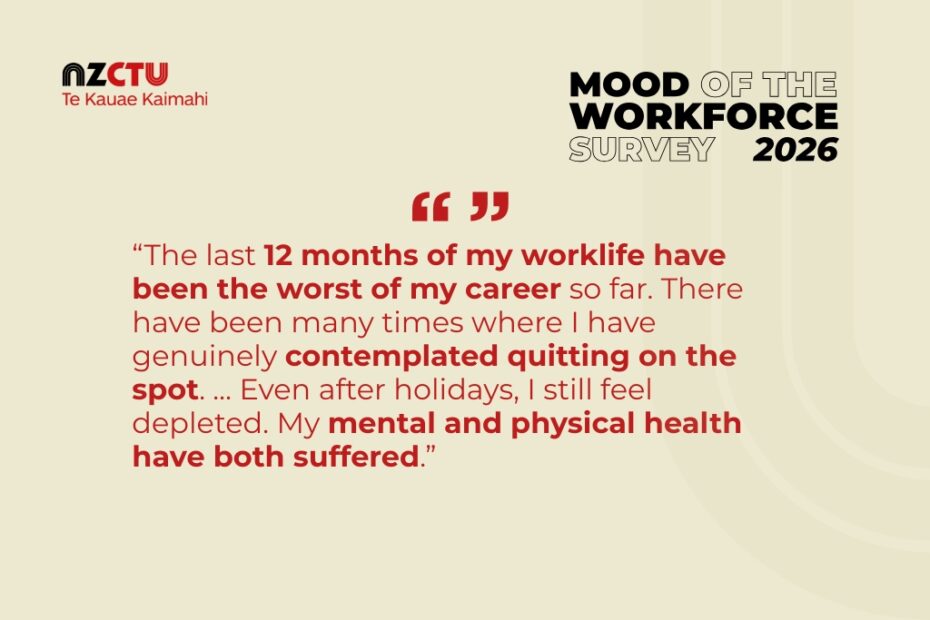
The Mood of the Workforce in 2026 is defined by rising cost-of-living pressures, deteriorating public services, and a lack of confidence in this Government. Working people consistently reported that wages are no longer keeping pace with costs, leaving even full-time workers struggling to afford basics like housing, food, and power. The financial stress is compounded by understaffing, long hours, and burnout, with many survey respondents feeling they are working harder for diminishing returns.
At the same time, frontline workers in health, education, and social services describe a system at breaking point due to funding cuts, poor workforce planning, and constant change. Many stated that public services are being deliberately run down to open the door to privatisation, increasing risk for both public sector workers and the public.
Underlying these pressures is a strong sense of political alienation. Respondents feel ignored, view the growing inequality in Aotearoa as unjust, and are angry at rollbacks of worker rights. The prevailing mood of respondents is exhausted, angry, and increasingly ready for change.
2026 saw the largest response since the Mood of the Workforce Survey was introduced in 2019. A total of 3,578 people responded over the survey period (4 January to 12 January 2026). In total 5,720 comments were made across the four sections of the survey.
This report presents the key findings on work and politics.
Variations in average responses across age and gender cohorts were statistically insignificant.
Similarly, differences in responses between unionised (~70%) and non-unionised (~30%) respondents were largely insignificant, except for responses regarding work-related outcomes. Union members’ responses showed they got pay rises more frequently than non-union members.
While the survey does not ask for people’s job titles, many identified their role in their comments. The survey included working people from a range of industries, including teachers, nurses, contractors, tradespeople, cleaners, factory workers, supermarket workers, waterside workers, seafarers, public servants, unemployed/part time/casual workers, self-employed, retired people, and emergency service workers.
We want to thank all those who took the time to complete the survey and urge employers and politicians to hear the distress, hardship and most importantly the solutions offered by the workers of Aotearoa.
Working Harder, and Still Falling Behind
“You have to work a lot harder/ be more productive, for a wage that doesn’t keep up with inflation. It’s like someone forgot we are people and deserve to be treated like people, not just an inconvenience to your profit.”
Material pressure is the dominant lived reality.
Workers who responded to the survey describe a relentless squeeze — wages that lag behind inflation; housing that is unaffordable; and full-time hours that no longer guarantee financial security.
“I work 40 hours and I’m not making enough to cover living expenses… once taxes are out there isn’t much left.”
“We are so behind a living wage, and it feels hopeless trying to live life independently as an adult.”
This pressure is compounded by long hours, understaffing, and burnout. Workers describe doing “more with less” while absorbing the emotional and physical cost themselves. Many respondents see no pathway forward in New Zealand, fuelling fears of brain drain and long-term workforce collapse.
“Work harder for longer but paid less… your wages don’t cover the basic rent, food etc.”
“I am constantly unable to make ends meet… I feel like I am working for no reward, only survival.”
“My mental health is declining because of the stress, anxiety and lack of funds to do the basics… I feel on the brink of tears more often because of what seems like a hopeless situation.”
Mood: These experiences are widely felt: Exhausted, anxious, and losing faith that work leads to stability.
“We are short staffed. We are doing multiple jobs in a day. We are exhausted and take frequent sick days to recover, however that puts more pressure on colleagues at work. The work life balance no longer exists as we are using our free time to recover.“
The effect is that 67.4% respondents did not feel they are fairly paid for their work. And a large number were waiting years for pay rises.
For 50.5% of respondents, their experience over the last 12 month has been a worsening work life balance, only 6% said it had got better. Despite working life getting harder, a poor labour market is affecting the ability of many working people to change jobs.
Many said that moving overseas would lead to them being better off, particularly for young workers.
“Work is a misery. Can’t get ahead in nz i was much younger I would leave nz for good… Sick of the low wage economy and lack of promotion opportunities. Innovation is discouraged.“
“Very sadly think that my children 19 and 21 yrs old, would be better off in Australia.”
One area that was seen much more positively with regard to working life was health and safety, with over 70% of respondents feeling like they are able to raise issues in their workplace.
However, this system is now under threat with changes proposed by the Government.
“The work we do is getting harder with less staff. We get to have a say about health and safety in the work place but not sure it is actually being heard. We work our butts of at work and we still struggle to pay our bills.“
Public Services Under Strain, Workers Carrying the Risk
Health, education, and social services are seen as being deliberately run down.
Frontline workers in health, education, and social services overwhelmingly describe systems at breaking point. Underfunding, staffing cuts, and constant top-down change are making it harder—sometimes impossible—to do their jobs safely or well. This is most acute in health, education, and social services, where workers feel both distressed and undermined.
“This is the worst environment I have worked in in 36 years of frontline practice! The health system is being decimated.”
“Recent changes in education have meant more work for teachers… ill-thought-through changes by people with no classroom experience.”
Many believe this deterioration is not accidental but strategic and designed to justify privatisation and roll back public provision. The result is rising risk for workers and the public, alongside collapsing morale.
“It appears this government is deliberately running these services into the ground so they can justify liquidating them.”
“Staff not replaced, causing workload increase… unsatisfactory experiences and life-or-death mistakes.”
The concerns about public service and the cost of living are expressed clearly by respondents when asked what the key issues are in an election year. When asked to rank their top issues, cost of living and the health system came out as the most critical issues to respondents.
The concern about cost of living was spoken of repeatedly by respondents in ways that show working people are one bill away from disaster, working unpaid overtime, and reducing their spending on basic items like food.
“The cost of living costs with 3 dependents has made it very difficult and I’ve had to work extra hours in a 2nd job to make ends meet.“
“Missed breaks every shift and finish late every shift“
“Working to struggle suxa-holes, getting sick of noodle lunches since food prices won’t stop sky rocketing.”
With regard to our health system, respondents spoke of the need to change the tax system to fund public services.
“If the wealthy paid the right amount of tax instead of hiding it through finding loopholes, we’d have enough to pay for health, education and housing for everyone.“
“We need to tax wealth and make sure our taxes are invested properly in health education and reducing the gap between rich and poor. NZ is a fantastic country blessed with a fair thinking majority who want to ensure we’re paid fairly, the poor are helped and the streets are safe. Marginalising people by taking away support systems and reducing benefits and making society more unequal creates division with potential for violence. This has to stop.“
Loss of Voice and Trust in Leadership
Workers feel ignored, undermined, and shut out of decision-making.
A deep sense of political alienation runs through the comments. Respondents consistently say their voices—and the expertise of frontline workers—are not being listened to. Decisions are seen as imposed, rushed, and ideologically driven, often against public opposition.
“The government does not listen to what New Zealanders want or think.”
“None of them are listening to people on the ground who are doing the work.”
This feeds a broader belief that the system now favours the wealthy at the expense of working people, with growing inequality seen as unjust and dangerous. Rollbacks of worker rights, health and safety protections, pay equity, and collective bargaining are experienced as a direct attack on dignity and fairness.
“The only people who seem to count are the wealthy.”
“Many of the gains made in the last 20 years are being reversed deliberately.”
The result is a high level of mistrust in the current leadership who are seen as creating rising social division. There is a strong desire for change from respondents—whether through voting, collective action, or stronger union power.
“They’re damaging lives and the future of this country.”
“Working people certainly are not respected… their well-being is constantly being undermined.”
Views of Our Political Leaders
Overall, workforce sentiment toward political leadership is largely negative toward the current Government. Workers overwhelmingly view Prime Minister Christopher Luxon as absent, ineffective, and out of touch. He is criticised for avoiding accountability and lacking conviction or empathy, with many seeing him as easily influenced and unfit to lead. Trust in his leadership is extremely low and calls for his removal are common.
“He only comes to light with announcements that they believe provide a public good.”
“I am particularly surprised at how bad Luxon’s performance has been, he’s so ‘absent’.”
“Fire Luxon and his muppet show.”
Ministers most associated with workplace, health, and economic settings, attracted strong criticism for being ideologically driven, inexperienced, and dismissive of workers and frontline expertise. They are perceived as actively making conditions worse, especially in health, education, and workplace safety.
Opposition and minor party leaders attract more nuanced views. Labour Party leader Chris Hipkins is generally seen as decent and trustworthy but too cautious and ineffective in opposition. Green Party co-leaders Chlöe Swarbrick and Marama Davidson receive some of the strongest positive feedback, viewed as principled, informed, and aligned with working people. Te Pāti Māori leaders are respected by supporters for their commitment to Te Tiriti and Māori communities but not generally seen as doing well on other issues.
The prevailing mood towards politicians is one of distrust, anger, and a desire for leadership that is credible, values-driven, and willing to stand up for workers.
Conclusion
“Workplace equality matters. Affordable health matters. Taking care of our environment matters. Making the rich richer does not.”
Working people across Aotearoa have made it clear they are suffering and feeling let down both economically and in terms of public services. Respondents see this as being caused by political and economic decisions that support the mega wealthy and big corporations. They want a more just New Zealand and bold policies that enable better living conditions.
“Young people are leaving in droves because they can’t get good jobs, good healthcare and a stable place to live. The idea of govt to help and support all NZers to have all the basics has to come back. I think young people would support that idea, now they’ve seen what can happen without it”
Workers are clear: they value leaders who are principled, compassionate, and stand up for people over profit. Survey responses praise honesty, courage, and advocacy for communities, while rejecting arrogance, indifference, and attacks on worker rights.
Respondents made it clear, it’s time for all of us to take action to ensure we have economic, social, and political decisions that put people first. As one worker put it:
“Until the ever-widening abyss between rich and poor can be addressed, Aotearoa will never be ‘back on track.'”
Related
- Back on Track? Not according to workers.
 Aotearoa New Zealand is way off track according to workers who took part in the CTU’s Mood of the Workforce Survey. Off track because… Read More »Back on Track? Not according to workers.
 - Workforce survey shows workers struggle to afford basics
 Rising costs, deteriorating public services, and a belief the government doesn’t care about ordinary New Zealanders are the key findings of the NZCTU Te… Read More »Workforce survey shows workers struggle to afford basics
 - Mood of the Workforce 2026
 The Mood of the Workforce in 2026 is defined by rising cost-of-living pressures, deteriorating public services, and a lack of confidence in this Government.… Read More »Mood of the Workforce 2026
 - The Real State of the Nation: Fear, Anger, and a Demand for Change
 Richard Wagstaff It was incredibly jarring to hear the hubris from the Prime Minister during his recent state of the nation address. I had… Read More »The Real State of the Nation: Fear, Anger, and a Demand for Change
 - “Something is very wrong in our society and economy” – NZCTU Workforce Survey shows people fear for future
 Insecurity in work, housing, and health among working people has emerged as the key finding from the New Zealand Council of Trade Unions Te… Read More »“Something is very wrong in our society and economy” – NZCTU Workforce Survey shows people fear for future
 - Mood of the Workforce 2025 resultsSince 2019, we have asked working people to talk about their experiences of work over the past 12 months, and what their thoughts are… Read More »Mood of the Workforce 2025 results
- Working people fear for their future and New Zealand’s
 The sixth annual CTU Mood of the Workforce survey shows working people are very worried about their incomes and rights under the new Government… Read More »Working people fear for their future and New Zealand’s
 - Mood of the Workforce 2024
 In the first week of every year since 2019, we have asked working people to talk about their experiences of work over the past… Read More »Mood of the Workforce 2024
 - Working people must not pay the price of fixing inflation – CTU
 Working people are bearing the brunt of the cost-of-living crisis with a record three out of four saying their incomes cannot keep up with… Read More »Working people must not pay the price of fixing inflation – CTU
 - Annual Mood of the Workforce Survey shows low wage economy hurting Kiwi workers
 As the New Zealand economy stares down the barrel of a potential omicron outbreak, workers are already feeling squeezed from low wages and high… Read More »Annual Mood of the Workforce Survey shows low wage economy hurting Kiwi workers
 - Work life survey: Ongoing worker dissatisfaction shows need for fundamental changeThis year’s CTU work life survey shows the need for a fundamental overhaul of New Zealand’s employment framework says CTU Secretary Melissa Ansell-Bridges. The… Read More »Work life survey: Ongoing worker dissatisfaction shows need for fundamental change
- Incomes better but still a long way to go – CTU 2020 work survey results
 The Council of Trade Unions Together 2020 work survey results released today show more people are reporting that their income kept up with their… Read More »Incomes better but still a long way to go – CTU 2020 work survey results